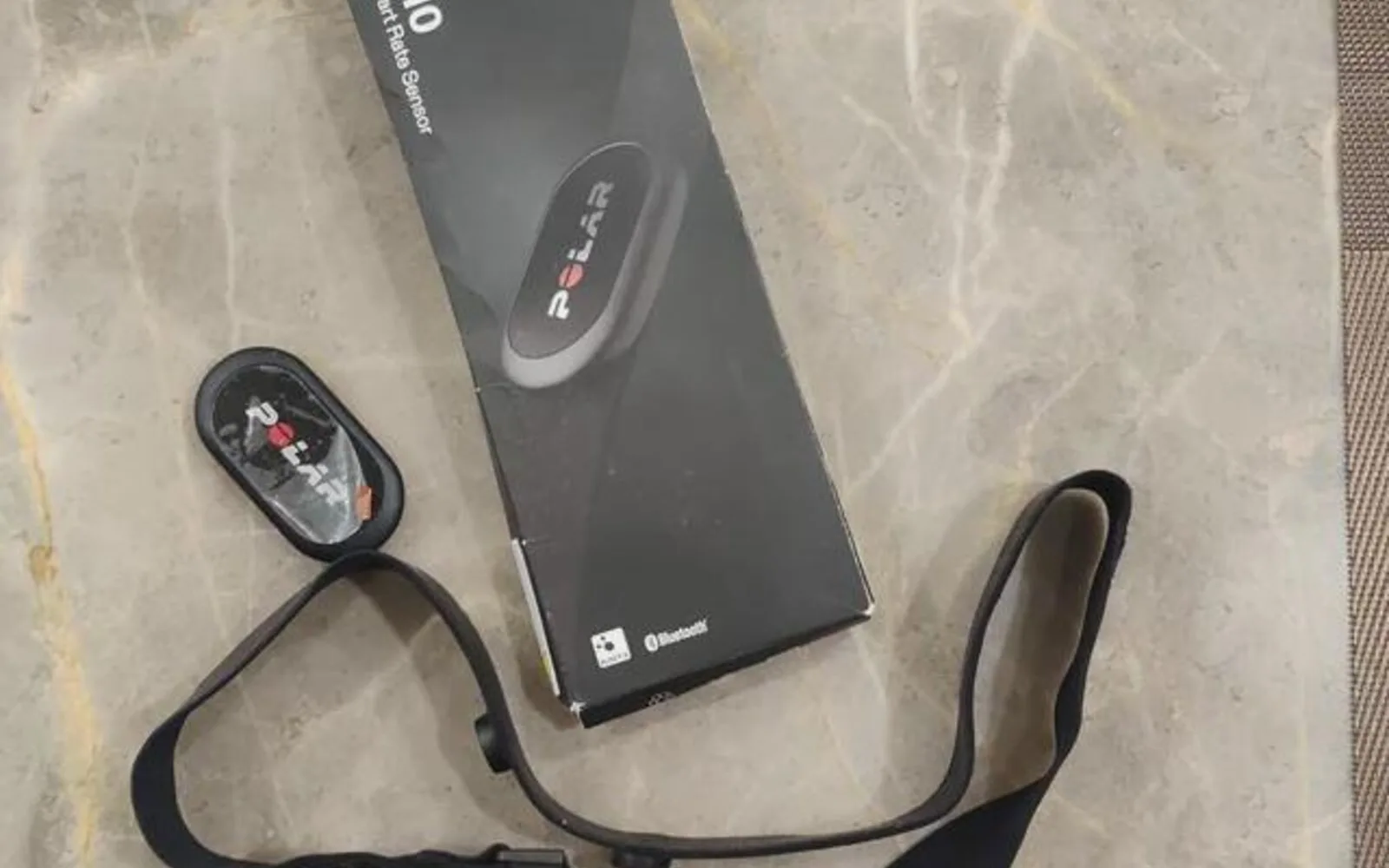
If your watch reads 130 bpm while you are clearly redlining, the watch is wrong, not your heart. Wrist heart rate is genuinely fine for steady cardio, resting trends and all-day tracking. It falls apart during intervals, high intensity, cold hands and over tattoos, and that is exactly when a chest strap earns its keep. The honest answer is situational, so here is how to pick.
| Wrist optical | Chest strap (ECG) | Upper-arm optical | |
|---|---|---|---|
| Best for | All-day trends and easy cardio | Intervals and zone training | Comfortable gym and run sessions |
| Accuracy on intervals | Often lags and smooths peaks | Near ECG agreement in lab tests | Better than wrist; may slip at peak HIIT |
| Comfort tradeoff | Highest convenience | Strap friction and setup | Band tightness without chest strap |
- Wrist optical
- All-day trends and easy cardio
- Chest strap (ECG)
- Intervals and zone training
- Upper-arm optical
- Comfortable gym and run sessions
- Wrist optical
- Often lags and smooths peaks
- Chest strap (ECG)
- Near ECG agreement in lab tests
- Upper-arm optical
- Better than wrist; may slip at peak HIIT
- Wrist optical
- Highest convenience
- Chest strap (ECG)
- Strap friction and setup
- Upper-arm optical
- Band tightness without chest strap
Two technologies, one design difference that explains everything
A wrist watch measures heart rate with photoplethysmography (PPG). Green LEDs shine light into your skin and a photodiode reads how much gets absorbed by blood pulsing through the capillaries. The watch infers your heart rate from that flickering signal. It is an indirect read of blood flow, not of the heart itself.
A chest strap uses electrodes to pick up the heart's electrical signal directly, the same kind of trace an ECG records. There is no inference and no guessing at blood flow. It captures precise beat-to-beat timing even under heavy load.
That single difference predicts almost every accuracy result that follows. An optical signal at the wrist can be smeared by motion, cold and ink. An electrical signal at the chest cannot.
What the evidence actually shows
The cleanest head-to-head comes from a 50-person Cleveland Clinic study (Gillinov et al., Medicine & Science in Sports & Exercise, 2017). The chest strap agreed almost perfectly with a clinical ECG, at a concordance of 0.996. Four popular wrist devices ranged from 0.67 to 0.92, and wrist error ran from roughly plus or minus 15 bpm up to plus or minus 34 bpm depending on the activity.
The error was not random. Wrist devices were most accurate at rest and at low treadmill intensity, and least accurate at high intensity. On an elliptical with moving arm levers, none of the wrist devices read correctly at all.
A separate Stanford study (Shcherbina et al., 2017) found most wrist devices tracked heart rate adequately in the lab, with median error from 2.0% to 6.8%. The same devices were hopeless on calories, with energy-expenditure error of 27% to 93%. So trust the heart-rate trend on your watch far more than the burn number next to it. They are not the same measurement, and the calorie figure is closer to a guess.
When wrist heart rate fails
Intervals and sprints. PPG needs several seconds of clean signal to confirm a new value. During a short, hard effort the watch can show around 130 bpm while your true heart rate is closer to 175 to 180. That lag is the sensor catching up, not your physiology being slow. The watch also smooths the peaks of work and the valleys of recovery into a vague curve that hides the real shape of the session.
Arm motion. Motion is the single biggest source of wrist PPG error. This is why the same watch can be fine on the bike and erratic on the run. Cycling keeps the wrist relatively steady, while running's repetitive arm swing injects artifact straight into the optical signal. The bike-versus-run gap is mechanical, not random.
Cold. When it is cold, blood flow to your hands drops and the sensor has a weaker signal to work with. A proper warm-up before you start improves cold-hand readings.
Tattoos. Ink absorbs and scatters the sensor's light. In one Polar Verity Sense study, readings over tattooed skin were off by 22.9% at rest, 7.5% walking and 5.1% running, while non-tattooed skin stayed inside the under-5% accuracy standard throughout.
Skin tone at high intensity. Accuracy can interact with skin tone under load. In a 2025 PLOS ONE study, a wrist device showed 3.5 bpm mean error on light skin at high intensity but 15.3 bpm on medium and 16.5 bpm on dark skin, roughly four times the error at peak effort for darker tones.
On an elliptical with moving arm levers, none of the wrist devices read correctly at all.Gillinov et al., Medicine & Science in Sports & Exercise, 2017
Where wrist heart rate is genuinely good enough
For resting heart rate trends, steady zone-2 cardio and all-day tracking, wrist PPG is well suited. It is cheap, comfortable and can monitor heart rate and rhythm over long stretches, which is exactly why it underpins consumer atrial fibrillation (AFib) screening.
That screening comes with a caveat. Consumer-watch AFib alerts generate real false positives. Algorithms trained in hospitals do not perform as well on the messier signals recorded in daily life, and clinics have seen waves of worried, healthy users flagged by their watch. Treat an irregular-rhythm alert as a prompt to get a proper ECG, not as a diagnosis.
So if your training is mostly steady efforts and you mainly want long-term trends, your watch is doing the job. You do not need to buy anything.
Who actually needs a chest strap
You benefit from a strap if your training is built on numbers. That means intervals, threshold work, or any structured plan that prescribes heart-rate zones. Zone work is only as good as the number it is built on, and a watch that smooths and lags will quietly put you in the wrong zone.
A strap also makes sense if you have heavily tattooed wrists, if you train in the cold, or if a clinician is monitoring your heart rate for a medical reason. None of these are elite-only situations. They are ordinary cases where the optical signal is physically compromised and a tighter band will not fix it.
If you run more than you cycle and you care about the data, that is another point toward a strap, because running is where wrist error is worst.
The middle ground nobody talks about
An upper-arm optical band is the option most people skip, and it is the best-value answer for a lot of athletes. It is still optical, but the upper arm moves far less than the wrist and has better tissue contact.
In a 2025 JMIR Cardio validation, the Polar Verity Sense worn on the upper arm had a bias of just -0.05 bpm and a mean absolute error of 1.43 bpm against an ECG chest strap. The same brand's wrist watch showed 2.56 bpm bias and 6.41 bpm error. The arm band held its accuracy at both low and high intensity, while the wrist read poorly at low heart rates and only improved as effort rose. Wearing position mattered as much as the device itself.
Part of why newer bands close the gap is hardware. Six-LED designs improved on older two-LED wrist sensors. They are not perfect at the very top end. In a 2025 school-based HIIT study, the Verity Sense correlated strongly with a chest strap overall (4 bpm error) but agreement slipped once effort passed about 80% of max heart rate. Even good optical sensors loosen up at peak. For most training, though, an arm band gets you most of the way to a strap without anything on your chest.
How to buy and how to wear it
Match the tool to the training, not to the marketing. If you mostly do steady efforts and want trends, keep your watch. If you train to numbers, get a chest strap or an upper-arm band. If you want one device that covers most cases comfortably, the upper-arm band is the sweet spot.
Whatever you wear, fit it well. A wrist sensor should sit snug and a little higher up the arm, away from the wrist bone, and you should warm up before cold-weather sessions to get blood into your hands. Better still, move the sensor off the wrist entirely to the upper arm or forearm, which beats any amount of strap-tightening. Dampen a chest strap's electrode contacts before you start so it reads from the first minute.
And ignore the calorie number on the screen. The heart-rate trend is the signal worth trusting. The burn figure is the one that is off by tens of percent.
FAQ
Is wrist heart rate accurate enough?
Fine for resting trends and steady Zone 2 cardio. It lags and misreads on intervals, cold hands and tattoos.
When do I need a chest strap?
When training uses heart-rate zones, intervals or threshold work where a smoothed wrist reading puts you in the wrong zone.
Chest strap or upper-arm band?
Chest is still the benchmark for beat-to-beat accuracy. Upper-arm optical bands are the comfortable middle ground for many athletes.
Why does my watch HR drop during sprints?
Optical sensors need clean signal time to catch up. Motion artifact during arm swing is the main culprit on runs.
Should I trust watch calorie burn?
No. Heart-rate trend is more useful than calorie estimates, which independent studies often miss by large margins.
Sources
- Wrist-worn heart rate monitors less accurate than standard chest strap (ACC / Cleveland Clinic; Gillinov et al., Medicine & Science in Sports & Exercise, 2017)
- Accuracy in wrist-worn, sensor-based measurements of heart rate and energy expenditure (Shcherbina et al., Stanford, 2017)
- Validity of heart rate measurements in wrist-based monitors across skin tones during exercise (PLOS ONE, 2025)
- Wrist-worn and arm-worn wearables for monitoring heart rate during physical activity (JMIR Cardio device validation, 2025)
- The effect of tattoos on heart rate validity in the Polar Verity Sense (2025)
- Validation of Polar Verity Sense for heart rate during school-based HIIT in adolescents (Journal of Sports Sciences, 2025)
- Atrial fibrillation monitoring with wrist-worn PPG-based wearables: a state-of-the-art review (PMC, 2020)
- Apple Watch heart rate accuracy and PPG motion artifact (ChatPPG explainer)
- Why wrist-based heart rate monitors could be undermining your training (Boost Coaching)
- What should you know about wrist heart rate (Suunto support)
Spot an error or have a product we should test? We read every note.
Get in touch