AI health coaches are useful when they turn your own data into a clearer next step: sleep earlier, train easier today, walk after dinner, or notice a pattern you keep ignoring. They become risky when they sound like a doctor, a therapist or a lab result interpreter without actually being one.
The short rule: use AI coaching for habits. Do not use it for diagnosis, medication decisions, mental-health crisis support or anything that would normally require a clinician.
| Use case | AI coach can help | Do not outsource |
|---|---|---|
| Training | Weekly plan, easier day, consistency nudge | Pain, injury diagnosis, return-to-sport clearance |
| Sleep | Routine, timing, consistency, caffeine reminders | Sleep apnea diagnosis or treatment |
| Nutrition | Meal logging, pattern spotting, protein reminders | Diabetes management or eating-disorder support |
| Health records | Summarising documents you already have | Explaining abnormal results without a clinician |
| Mental health | Basic habit prompts and journalling | Crisis care or therapy replacement |

- AI coach can help
- Weekly plan, easier day, consistency nudge
- Do not outsource
- Pain, injury diagnosis, return-to-sport clearance
- AI coach can help
- Routine, timing, consistency, caffeine reminders
- Do not outsource
- Sleep apnea diagnosis or treatment
- AI coach can help
- Meal logging, pattern spotting, protein reminders
- Do not outsource
- Diabetes management or eating-disorder support
- AI coach can help
- Summarising documents you already have
- Do not outsource
- Explaining abnormal results without a clinician
- AI coach can help
- Basic habit prompts and journalling
- Do not outsource
- Crisis care or therapy replacement
Why this is happening now
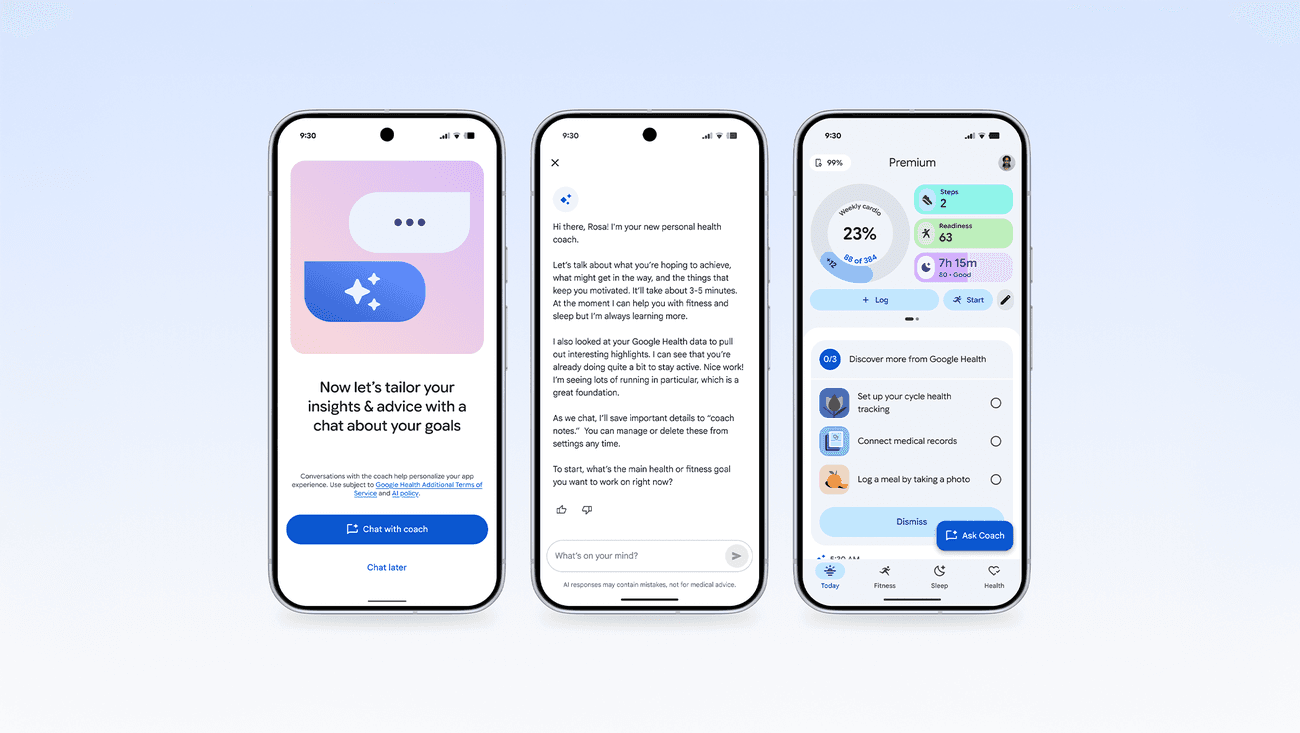
Google has moved Fitbit into a broader Google Health app and launched Google Health Coach, built with Gemini, as part of Google Health Premium. The official Google Health Coach page says it can provide personalised fitness, sleep and wellness guidance, create workout plans, answer questions about metrics and summarise medical records.
That sounds powerful because it is. It also comes with the fine print that matters: features are not intended for medical purposes, availability varies, and users should check responses for accuracy. That is not boilerplate. That is the line between useful context and misplaced trust.
Listen when the advice is behavioural
AI is good at turning patterns into prompts. If your wearable shows late caffeine, short sleep and higher resting heart rate, a coach telling you to pull back training or protect bedtime is probably useful. If it notices you always miss workouts after back-to-back late nights, that is also useful.
This is where AI shines: habit reminders, consistency tracking, simple plan adjustments and summarising trends. It is less glamorous than a chatbot pretending to be House, but it is where the risk is lower and the payoff is real.
Ignore it when the advice becomes clinical
If an AI coach tells you a symptom is harmless, suggests supplement changes around medication, interprets abnormal blood work, comments on chest pain, or gives mental-health advice beyond basic support, stop. Use it to prepare questions for a clinician, not to replace one.
The same applies to wearable metrics. A readiness score, HRV trend or sleep-stage estimate can inform behaviour, but it is not a diagnosis. Your watch does not know your full medical history, your family history, your exam findings or what you forgot to mention.
The privacy question is not optional
AI coaching needs data. That may include sleep, activity, heart rate, cycle information, meals, symptoms and sometimes medical records. Google says Fitbit users' health and wellness data will not be used for Google Ads, but that does not remove the need to understand app permissions, data sharing and account settings.
Before you connect more apps, ask what the coach needs, what it stores, whether it shares with partners, and what you can delete. Convenience is nice. A health-data junk drawer is not.
What to do before paying
Start with the free version of whatever app you already use. If the paid AI layer mostly gives motivational summaries, skip it. If it helps you train more consistently, sleep more predictably or understand a specific metric without panic, it may be worth a trial.
For most readers, the best paid health coach is still a human one for injury, body-composition change, chronic disease, pain, pregnancy, medication, mental health or confusing symptoms. AI can help you bring better data to that conversation. It should not be the conversation.
Bottom line
Use AI health coaches for habits, planning and pattern recognition. Do not use them as a clinician, therapist, dietitian or emergency line.
If the answer could change medication, delay care or make you ignore symptoms, the chatbot has left its lane.
FAQ
When should I trust AI health coaching?
Use it for habits: sleep timing, training consistency, meal logging and pattern spotting. Do not use it for diagnosis, medication decisions or mental-health crisis support. That is not medical advice.
Can an AI coach replace my doctor?
No. AI coaching is useful as a habit assistant, not a medical authority. If it interprets abnormal blood work, comments on chest pain or suggests supplement changes around medication, stop and speak to a clinician.
Are readiness scores and HRV trends diagnoses?
No. Wearable metrics can inform behaviour, but they are not clinical results. Your watch does not know your full medical history or exam findings.
What should I check before connecting more health data?
Ask what the coach stores, who it shares with, and what you can delete. AI coaching needs sleep, activity, heart rate and sometimes medical records, so understand permissions before you opt in.
Is Google Health Coach available everywhere?
Availability varies by region and subscription tier. Check Google's own pages for current Singapore access, and treat any response as something to verify rather than clinical guidance.
Sources
- Google Health Coach
- Google: Google Health Coach is now available to Premium users
- Google: Introducing the Google Health app
- FDA general wellness policy for low-risk devices
- Which fitness tracker numbers are real?
- Sleep hygiene that actually works
Spot an error or have a product we should test? We read every note.
Get in touch