
Here is the most useful thing you'll read about your first running shoe: it should be a comfortable, neutral, well-cushioned daily trainer that actually fits your foot. That's it. The carbon-plated "super shoe" arms race that fills your feed is built for racing and fast runners, not week-one runners, and the science is surprisingly relaxed about how much any of this matters when you're starting out.
So instead of another breathless ranking, here's the honest version: the seven proven daily trainers that running-shoe reviewers keep putting in front of new runners, what their published specs actually mean in plain English, and a short section on how to pick without overthinking it.
| Pick | Best for | Drop / weight (lab) | Indicative price (SGD) |
|---|---|---|---|
| ASICS Gel-Nimbus 27 | Plush default | 8.3 mm drop · 299 g | S$259 |
| Brooks Ghost 16 | Safe first pair | 12.4 mm drop · 266 g | S$200–270 band |
| Nike Pegasus 41 | Versatile classic | 11.4 mm drop · 281 g | S$200–270 band |
| Hoka Clifton 9 | Soft but light | 6.1 mm drop · 249 g | S$200–270 band |
| New Balance 1080v14 | Plush, low-drop | 4.2 mm drop · 298 g | S$200–270 band |
| Brooks Glycerin 22 | Premium step-up | Max cushion sibling to Ghost | S$200–270 band |
| ASICS Gel-Kayano 31 | Stability only | 11.5 mm drop · 311 g | S$200–270 band |
- Best for
- Plush default
- Drop / weight (lab)
- 8.3 mm drop · 299 g
- Indicative price (SGD)
- S$259
- Best for
- Safe first pair
- Drop / weight (lab)
- 12.4 mm drop · 266 g
- Indicative price (SGD)
- S$200–270 band
- Best for
- Versatile classic
- Drop / weight (lab)
- 11.4 mm drop · 281 g
- Indicative price (SGD)
- S$200–270 band
- Best for
- Soft but light
- Drop / weight (lab)
- 6.1 mm drop · 249 g
- Indicative price (SGD)
- S$200–270 band
- Best for
- Plush, low-drop
- Drop / weight (lab)
- 4.2 mm drop · 298 g
- Indicative price (SGD)
- S$200–270 band
- Best for
- Premium step-up
- Drop / weight (lab)
- Max cushion sibling to Ghost
- Indicative price (SGD)
- S$200–270 band
- Best for
- Stability only
- Drop / weight (lab)
- 11.5 mm drop · 311 g
- Indicative price (SGD)
- S$200–270 band
What a beginner's shoe actually needs (and what it doesn't)
Strip away the jargon and a good first shoe does three things. It cushions your landing so easy runs feel easy. It's stable and predictable so your foot isn't fighting the shoe. And it fits: true to length, snug at the heel, room at the toes.
That's the whole brief. Notice what's missing: a stiff plate, a "race-day" energy-return number, a colour-matched outfit. Buying guides from running specialists like Fleet Feet land in the same place: neutral, balanced trainers such as the Nike Pegasus, Hoka Clifton, Saucony Ride and Brooks Ghost get named again and again precisely because they're "unlikely to offend." Boring is the point. Boring is what builds the habit without hurting you.
A quick honesty note before we go further: The Catalyst Feed has not physically run in these shoes. This guide is built on lab-measured specifications and the consensus of credible reviewers who have. Where we quote a stack height or weight, it's the independently measured figure from RunRepeat's lab, not the marketing claim, and the two don't always agree.
Decoding the spec sheet: stack, drop, weight, neutral vs stability
Four numbers tell you most of what you need to know.
- Stack height is how much foam sits between your foot and the road, measured in millimetres at the heel and forefoot. More stack means a softer, more protective ride. The shoes here run from roughly 33 mm to nearly 43 mm at the heel: all firmly in "cushioned" territory.
- Heel-to-toe drop is the difference between heel stack and forefoot stack. A 12 mm drop tips you forward and tends to feel more "traditional"; a 4–6 mm drop sits flatter and feels more natural to some runners. Neither is correct. It's a feel preference, and a bigger change in drop is something your legs adapt to over weeks, not minutes.
- Weight is straightforward: lighter generally feels friskier, heavier often feels more planted and plush. The spread below is about 249 g to 311 g for a men's pair.
- Neutral vs stability is the big fork. Most runners do fine in neutral shoes. Stability shoes add structure to guide a foot that rolls inward a lot (overpronation). You don't pick stability because it sounds safer: you pick it only if you actually need the guidance.
The seven daily trainers worth your money
These are the proven picks, with lab-measured specs (men's, per RunRepeat). All seven sit in the premium daily-trainer band: in Singapore that's broadly S$200–270 at recommended retail, so let comfort and fit, not a S$20 gap, make the call.
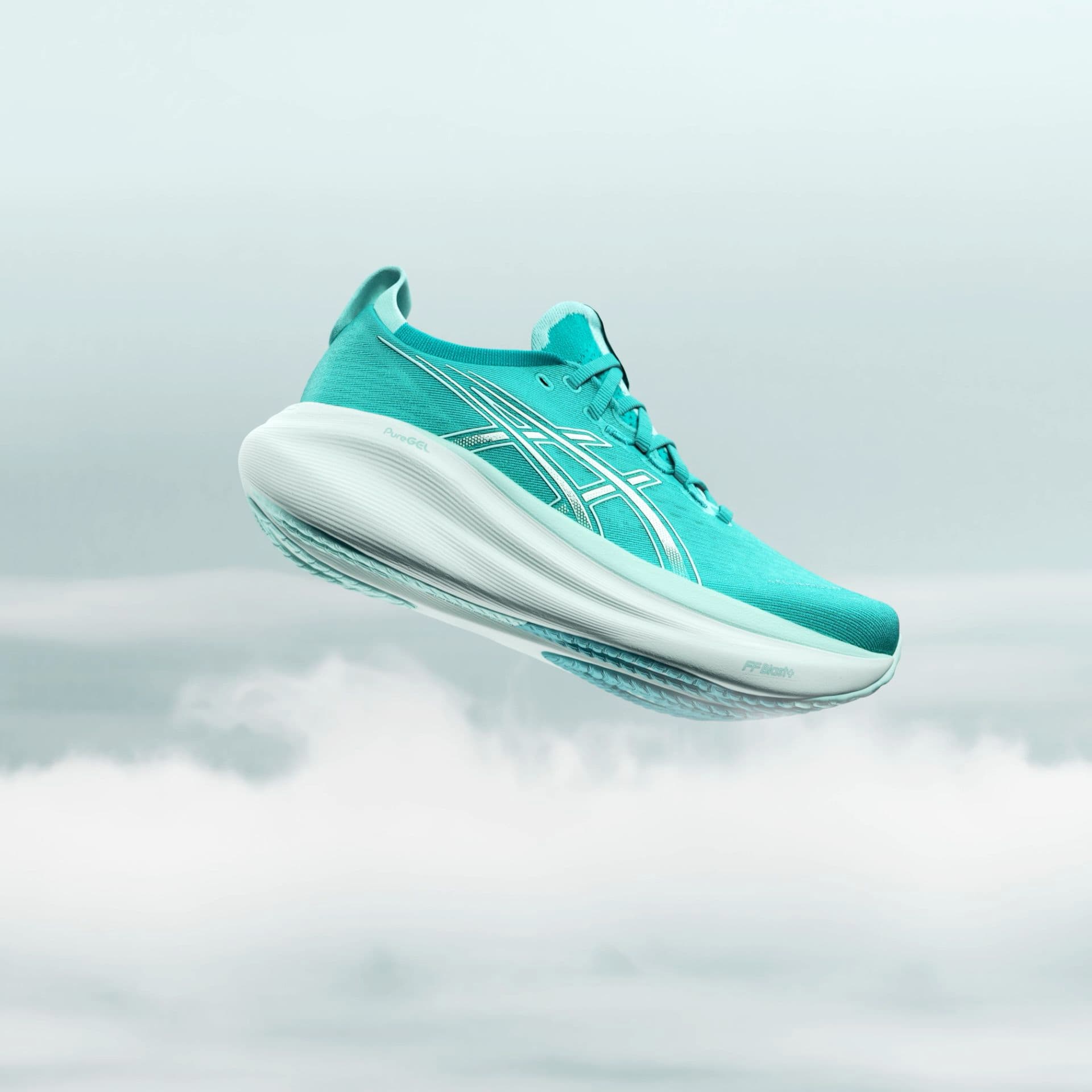
ASICS Gel-Nimbus 27: the plush default. Neutral, maximum cushioning. RunRepeat measured it at 42.7 mm heel / 34.4 mm forefoot, an 8.3 mm drop, and 299 g: the most foam underfoot here. It launched in Singapore on 1 January 2025 at an official retail price of S$259. If you want the softest, most protective landing for easy and recovery runs and don't mind a little extra weight, this is the comfortable starting line.
Brooks Ghost 16: the textbook safe first pair. Neutral, with a nitrogen-infused DNA Loft v3 midsole. Measured at 35.1 mm / 22.7 mm, a higher 12.4 mm drop, and 266 g. Predictable, comfortable, no drama. If you want one shoe that just works for everyday runs and can't be bothered weighing options, buy this and stop reading.
Nike Pegasus 41: the versatile classic. Neutral, with ReactX foam and Air Zoom units. Measured at 33.6 mm / 22.2 mm, an 11.4 mm drop, and 281 g. Lower-profile than the max-cushion options, which makes it handle easy runs and the occasional faster effort without feeling like a marshmallow. A no-nonsense all-rounder.
Hoka Clifton 9: soft but light. Neutral and cushioned, yet the lightest here at 249 g. Measured at 32.7 mm / 26.6 mm with a low 6.1 mm drop. The smooth rockered ride and low weight make it a favourite for easy runs, recovery days and even walks. Good if "cushioned" usually means "heavy" to you and you'd rather it didn't.
New Balance Fresh Foam X 1080v14: plush and low-drop. Neutral, very high cushioning, with a rockered sole and soft jacquard upper. Measured at 37.0 mm / 32.8 mm, a low 4.2 mm drop, and 298 g. A premium, natural-feeling alternative to the Nimbus for long, slow mileage when you want max softness sitting closer to flat.
ASICS Gel-Kayano 31: the support pick. This is the only stability shoe here. Maximum cushioning plus a 4D Guidance System for runners who roll inward. Measured at 39.3 mm / 27.8 mm, an 11.5 mm drop, and 311 g (the heaviest). Choose it only if a fitter or physio tells you that you genuinely need support, not as a default.
Why you don't need carbon plates yet
The shoes splashed across race coverage have a stiff carbon plate inside. They're engineering marvels for fast runners, and almost beside the point for a beginner.
A 2020 study in Scientific Reports tested 15 athletes and found that adding carbon-fibre plates to shoe soles did not meaningfully improve running economy: the stiffest version showed only a non-significant 0.3% change in aerobic power versus baseline. Reviewers and coaches reach the same conclusion: super shoes suit experienced, faster runners who can load the plate hard enough to get something back. Run slower, and you simply can't bend it the way it needs to be bent. That rigid plate can also pile extra stress on muscles and joints if you wear it every day, which is the wrong trade-off when you're building a base.
Spend the money on a comfortable daily trainer and a proper fitting. The plate can wait until you have a goal race and the speed to use it.
How to pick your first pair without overthinking it
A short, practical sequence:
- Get fitted in person. Go to a running shop, ideally later in the day when your feet have swollen slightly, and try several pairs. A good fitter watches you walk or jog and reads your gait far better than any online quiz. Buy the pair that feels best on the run: that's the most reliable signal you have.
- Comfort beats every spec. If two shoes both fit and one simply feels better, that's your shoe. The numbers above narrow the field; your foot makes the final call.
- Get the size right. Running shoes usually need a touch more room than your everyday size: about a thumb's width at the front, because feet swell and slide forward on the run. Don't size by the badge; size by how it feels with running socks on.
- Skip stability unless you need it. Most beginners are fine in neutral. Reach for the Kayano only if you've been told you overpronate or you clearly feel you need the guidance.
- One pair is enough to start. You don't need a rotation, a race shoe or a plate. You need a comfortable trainer and a few easy runs a week.
One last note, because this is health territory: pain that builds and lingers isn't something a shoe fixes. Niggles, sharp aches or anything that worsens run to run are worth raising with a physiotherapist or sports doctor. This guide is about choosing gear, not diagnosing injuries. When in doubt, talk to a professional.
Pick the comfortable one. Get it fitted. Go run. The fancy stuff will still be there when you're faster.
FAQ
What running shoe should a beginner buy?
A cushioned daily trainer from a reputable brand, fitted in store if possible. Skip super shoes until you have consistent weekly mileage.
How much should beginners spend on shoes?
Enough for a current-model daily trainer, often S$150 to S$220 at full retail. Check current sales before paying launch price.
Do beginners need stability shoes?
Not automatically. Moderate overpronation often resolves with strength work. Get gait advice rather than defaulting to heavy stability.
How should running shoes fit?
Thumb width at the toe box, snug midfoot, no heel slip. Try with the socks you run in and test after a short jog in store.
One pair or rotate two?
One pair works at low mileage. Rotating helps shoes dry between humid Singapore runs and extends lifespan.
Sources
- Fleet Feet: Best running shoes for beginners 2026
- Fleet Feet: Best running shoes 2026
- RunRepeat: ASICS Gel-Nimbus 27 lab review
- ASICS Singapore: Gel-Nimbus 27
- SportPlus: ASICS Gel-Nimbus 27 Singapore launch
- RunRepeat: Brooks Ghost 16 lab review
- RunRepeat: Nike Pegasus 41 lab review
- RunRepeat: Hoka Clifton 9 lab review
- RunRepeat: New Balance Fresh Foam X 1080 v14 lab review
- RunRepeat: ASICS Gel-Kayano 31 lab review
- Tom's Guide: Brooks Glycerin 22 review
- Scientific Reports: carbon fibre plates and running economy
- Frontiers: metabolic effects of carbon-plated running shoes
Spot an error or have a product we should test? We read every note.
Get in touch

