Something quietly broke in the running-watch market, and it works in your favour. Dual-frequency (multiband) GPS, AMOLED screens and 30-hour-plus batteries used to be flagship bragging rights. In 2026 they're standard kit on a S$339 watch. The old logic of "spend more, run more accurately" no longer holds, which changes the whole buying decision.
So this isn't a tested-and-ranked leaderboard. We haven't strapped these to our wrists for a marathon block. It's a research-backed guide built on published manufacturer specs and the consensus of reviewers who genuinely test this stuff for a living: DC Rainmaker, the5krunner, iRunFar and Wareable. The goal is to match the watch to your training, not to the spec sheet.
| Pick | Best for | Standout | Indicative price (SGD) |
|---|---|---|---|
| Garmin Forerunner 970 | Best overall | Training depth, on-watch maps, ECG | ~S$1,029 |
| Apple Watch Ultra 3 | Best for iPhone runners | Dual-frequency GPS, do-everything device | ~S$1,261 |
| Coros Pace 3 | Best value | Dual-frequency GPS, up to 38 h GPS battery | S$311–339 |
| Coros Apex 4 | Best battery & trail | 41–50 h GPS, offline topo maps | S$640–720 |
| Garmin Forerunner 165 | Best budget | AMOLED Garmin, no multiband GPS | ~S$238–379 |
- Best for
- Best overall
- Standout
- Training depth, on-watch maps, ECG
- Indicative price (SGD)
- ~S$1,029
- Best for
- Best for iPhone runners
- Standout
- Dual-frequency GPS, do-everything device
- Indicative price (SGD)
- ~S$1,261
- Best for
- Best value
- Standout
- Dual-frequency GPS, up to 38 h GPS battery
- Indicative price (SGD)
- S$311–339
- Best for
- Best battery & trail
- Standout
- 41–50 h GPS, offline topo maps
- Indicative price (SGD)
- S$640–720
- Best for
- Best budget
- Standout
- AMOLED Garmin, no multiband GPS
- Indicative price (SGD)
- ~S$238–379
What actually matters in 2026 (and what doesn't)
Let's clear the big myth first. You probably don't need multiband GPS as much as the marketing implies. Dual-frequency (L1 + L5) reception helps most in genuinely hostile environments: dense downtown canyons of glass towers, tight tree cover on trails. If your weekly running is suburban roads, park connectors and the occasional track session, a good single-frequency watch will track you just fine.
What separates these watches now isn't raw accuracy. It's three other things:
- Software depth, how seriously the platform handles structured workouts, intervals, recovery and training load.
- Ecosystem lock-in: Garmin, Coros, Apple and Polar each want you to stay. Your data, your app, your habits all live there.
- Battery headroom: enough charge to track your longest event with GPS on, plus a buffer.
Pick a watch around those, and the price you pay drops a lot. Most runners should be buying down the ladder, not up.
Best overall: Garmin Forerunner 970
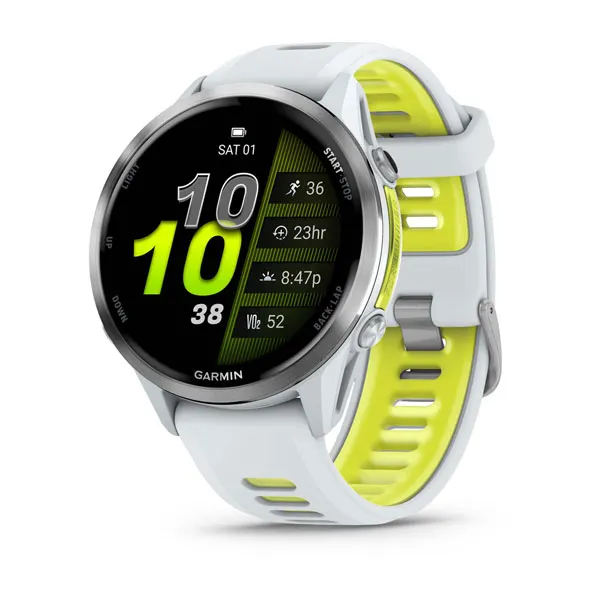
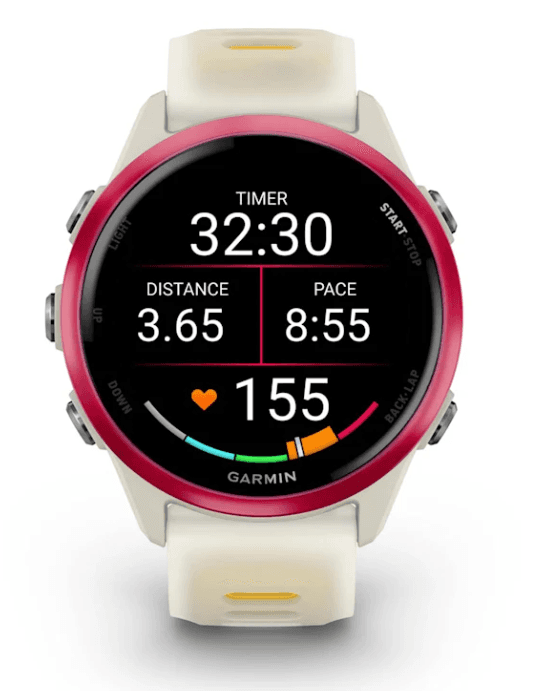
Garmin's flagship Forerunner earns the top slot, but not for the reason you'd think. Per DC Rainmaker's in-depth review, the 970 doesn't track meaningfully better than a watch costing a third as much. What it gives you is depth: the most complete training-analytics suite Garmin makes, full on-watch mapping, ECG, a skin-temperature sensor, an LED flashlight and proper triathlon and multisport support.
The hardware is genuinely premium. A 47mm case at 56 g, a 1.4-inch AMOLED touchscreen (454 x 454) under a sapphire lens with a titanium bezel, and the brightest screen in the Forerunner line. Battery runs up to 15 days in smartwatch mode; GPS recording goes up to 26 hours GPS-only, 23 hours on SatIQ auto-select, and 21 hours in all-systems multiband, dropping to roughly 12 to 14 hours with music playing. That's enough to track an Ironman or a long ultra without anxiety.
The catch is the price. It launched in 2025 at US$749.99 (up from the FR965's US$599) and sells in Singapore around S$1,029. That's a lot of watch. If you're a serious runner or triathlete who lives in training data and wants maps on your wrist, it's superb. If you run a 5K three times a week, it's overkill and you know it.
Best for iPhone runners: Apple Watch Ultra 3
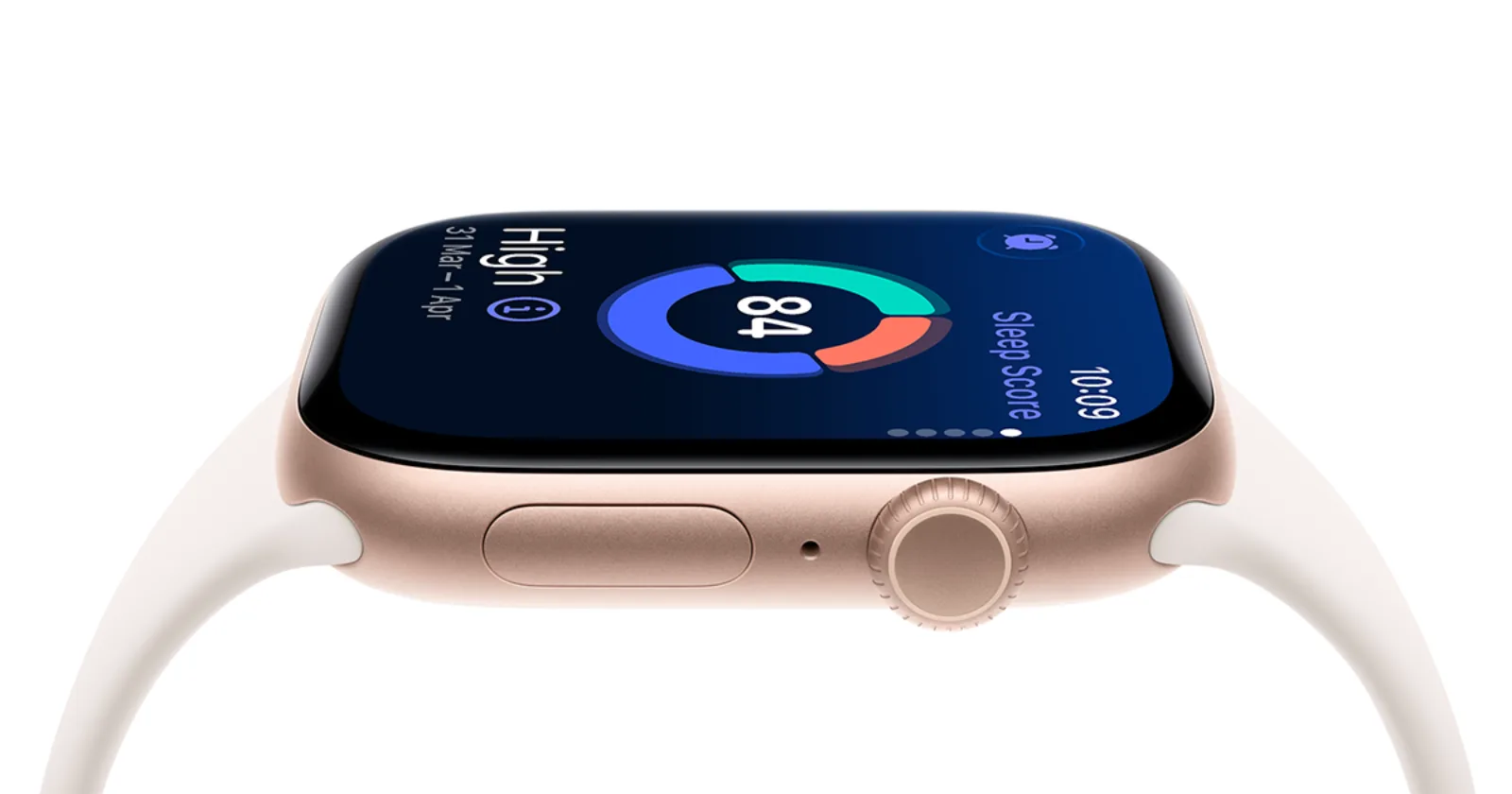
If your phone is an iPhone and you want one device for running, daily smartwatch duty, comms and safety, the Apple Watch Ultra 3 is the obvious answer. Apple finally gave it precision dual-frequency GPS (L1 + L5) with new positioning algorithms, so the running tracking is now properly competitive rather than an afterthought.
The hardware is a showcase. A 49mm Grade 5 titanium case (49 x 44 x 12 mm) at about 61.6 g, Apple's largest-ever display hitting up to 3,000 nits peak brightness, plus 5G and satellite messaging for when you're off-grid. Battery is up to 42 hours in normal use, stretching to 72 hours in Low Power Mode, and it charges 0 to 80% in roughly 45 minutes. It starts at US$799, around S$1,261 in Singapore.
Two honest caveats. It's iOS-only, so it's useless to Android users. And its structured-training depth still trails Garmin and Coros. Reviewers consistently note that dedicated running platforms simply think harder about workouts and recovery. The Ultra 3 is the best running watch for someone who wants a do-everything Apple device, not the best running watch full stop.
Best value: Coros Pace 3
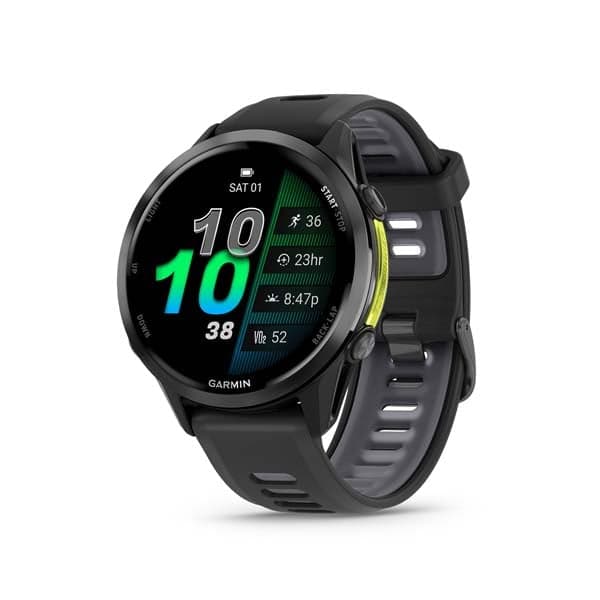
Here's the watch most runners should actually buy. The Coros Pace 3 delivers dual-frequency GPS, a serious training platform and a featherweight build for US$229, roughly S$311 to S$339 in Singapore. It is, by some distance, the smartest money in this guide.
It weighs about 30 g on the nylon strap (38 g on silicone), which you stop noticing within a run. The 1.2-inch display is modest but readable. Battery is the headline: up to 24 days in smartwatch mode, up to 38 hours of standard GPS, up to 15 hours in dual-frequency mode at full accuracy, and around 25 hours in all-systems mode. Per DC Rainmaker, its dual-frequency reception draws on multiple satellite systems for a strong lock. It also stores music (4GB) and reads SpO2.
What do you give up versus Garmin? A smaller, simpler screen, a less polished app, and the deep ecosystem of Connect IQ apps and on-watch maps. For most runners chasing real data without flagship spend, none of that is a dealbreaker. The Pace 3 is the default pick, and the one we'd point a friend to first.
Best battery and best for trail: Coros Apex 4
When charging is a luxury (multi-day ultras, back-to-back big mountain days, expedition trekking) battery becomes the whole ballgame. The Coros Apex 4, announced October 2025, is built for exactly that. iRunFar quotes around 41 hours of GPS use, and DC Rainmaker logged roughly 50 hours on a real-world navigation-heavy hike, comfortably beyond the spec. That's days, not hours.
You also get a titanium bezel with sapphire glass, a Memory-in-Pixel display tuned for battery efficiency, precision dual-frequency GPS, and full global offline topo and street maps with turn-by-turn navigation. There's a built-in speaker and mic for calls and voice pins. The 46mm weighs about 64 g and costs US$479 (US$429 for the 42mm), roughly S$640 to S$720. iRunFar flags it as a genuine value standout: sapphire, offline maps and multi-day endurance at well under half a flagship's cost. For long days where the route matters and the charger stays home, this is the one.
Best budget: Garmin Forerunner 165
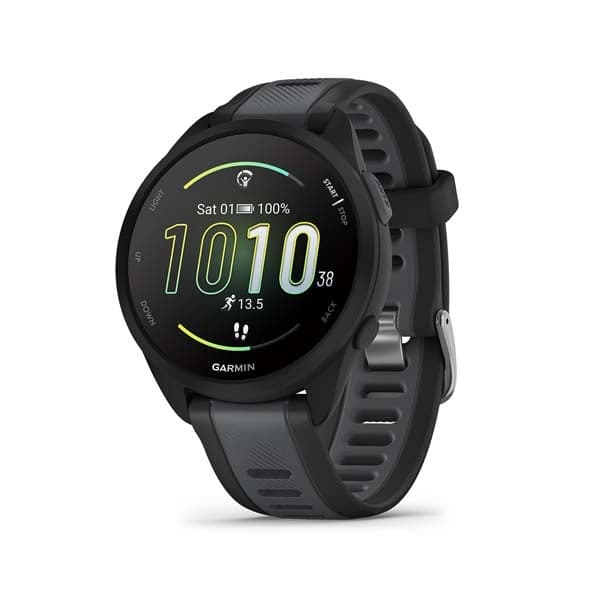
Want into Garmin's mature training ecosystem for the least money? The Forerunner 165 is the door. At US$249.99 (US$299.99 for the Music edition), with an RRP of S$379 that frequently drops to around S$238 on sale, it's the cheapest way to get an AMOLED Garmin with proper structured training.
It weighs 39 g with a 1.2-inch AMOLED touchscreen (390 x 390) in a plastic case. Battery runs up to 11 days in smartwatch mode (about 4 days with always-on display), with GPS up to 19 hours GPS-only and 17 hours on all-systems. The honest trade-off, flagged clearly by DC Rainmaker: it uses multi-GNSS (GPS, GLONASS, Galileo) but no multiband. So in dense city or heavy tree cover, accuracy slips versus the pricier tiers. For road running, 5K and 10K training, and a first marathon, it's more than enough, and you get the same trusted Garmin training tools as the flagship.
How to choose: match the watch to your training
Cut through it like this.
- 5K, 10K and easy weekly runs: Garmin Forerunner 165 or Coros Pace 3. You do not need multiband or multi-day battery. Save the money.
- First marathon, structured training: Forerunner 165 (budget) or Pace 3 (value, lighter, longer battery). Both handle intervals and recovery metrics properly.
- Serious performance, triathlon, you love data and maps: Forerunner 970. The depth is real, and you'll use it.
- Ultras and trail, multi-day routes: Coros Apex 4. Battery and offline maps win the day.
- iPhone household, want one device for everything: Apple Watch Ultra 3, as long as you're not chasing the deepest training analytics.
If you've already settled on Garmin and just want the right model for Singapore pricing, our best Garmin watches in Singapore guide ranks the line by job. And if you're still torn between the two big ecosystems, the Garmin vs Apple Watch comparison breaks the choice down to battery, training depth and which phone is in your pocket.
The instinct to spend up is mostly marketing. A S$339 Coros Pace 3 covers the vast majority of runners completely. Buy the watch your training needs, commit to that brand's app for the long run, and put the saved money toward race entries and shoes. That's where it'll actually make you faster.
FAQ
Best smartwatch for running in 2026?
Garmin Forerunner line for battery and training analytics. Apple Watch Ultra 3 for iPhone users who want dual-frequency GPS.
Do runners need music on the watch?
Nice to have, not required. Many runners carry a phone or use bone-conduction headphones paired to either watch or phone.
Chest strap with a running watch?
Worth it for interval sessions. Steady easy runs are fine on wrist optical HR alone.
Garmin or Coros for running?
Both serve serious runners well. Pick by ecosystem, map needs, shop support in Singapore and current model pricing.
How accurate is watch GPS in Singapore?
Open park connectors are reliable. Dense CBD and tree cover still cause wobble on any brand. Test your loop before racing on watch pace.
Sources
- Garmin Singapore: Forerunner 970
- DC Rainmaker: Garmin Forerunner 970 in-depth review
- Apple: Apple Watch Ultra 3 specs
- Coros: Pace 3
- DC Rainmaker: Coros Pace 3 review
- Coros: Apex 4
- DC Rainmaker: Coros Apex 4 review
- iRunFar: Coros Apex 4 review
- Garmin: Forerunner 165
- DC Rainmaker: Garmin Forerunner 165 review
Spot an error or have a product we should test? We read every note.
Get in touch