
If you only remember one thing: in Singapore the sticker price is rarely the real price. Some of these devices charge you again every month, some lose their local warranty the moment you buy them overseas, and some stop working entirely if you cancel a subscription. Pick by the job you need done, buy from an authorised local seller, and read the fine print on recurring costs before the box ever opens.
This is a buyer's guide by use-case, not a scored review. We only put a number on gear we've tested against a repeatable method, so the verdicts here point you to a category and to our hands-on reviews for the call. It is part of our fitness wearables and trackers hub, where the recovery reviews and budget picks live alongside this guide.
| Use-case | Pick | Realistic SGD |
|---|---|---|
| Best overall (iPhone) | Apple Watch Series 11 / SE 3 | S$319–S$779 |
| Best overall (Android) | Pixel Watch 3 / Galaxy Watch | S$449–S$1,080 |
| Best for runners | Garmin Forerunner 165 | S$379–S$459 |
| Best for recovery & sleep | Oura Ring 4 / Whoop 5.0 | S$118–S$599 + subscription |
| Best budget | Xiaomi Smart Band / HPB AXTRO Fit | Free–under S$100 |
- Pick
- Apple Watch Series 11 / SE 3
- Realistic SGD
- S$319–S$779
- Pick
- Pixel Watch 3 / Galaxy Watch
- Realistic SGD
- S$449–S$1,080
- Pick
- Garmin Forerunner 165
- Realistic SGD
- S$379–S$459
- Pick
- Oura Ring 4 / Whoop 5.0
- Realistic SGD
- S$118–S$599 + subscription
- Pick
- Xiaomi Smart Band / HPB AXTRO Fit
- Realistic SGD
- Free–under S$100
Best overall everyday watch
Apple Watch (Series 11 or SE 3) if you carry an iPhone. This is the easy answer for iPhone users and a non-answer for everyone else, because most of what makes it good evaporates on Android. For a scored Series 11 breakdown, see our Apple Watch Series 11 review (8.3/10).
Why it matters: there's no subscription, which over three years quietly makes it cheaper than it looks next to the membership devices below.
Pixel Watch 3 or a Samsung Galaxy Watch if you're on Android. The Pixel Watch 3 runs about S$449 to S$529 on the Google Store Singapore. Samsung's Galaxy Watch Ultra sits higher, roughly S$748 to S$1,080 depending on retailer and connectivity. Both sync with Healthy 365 through Samsung Health, which matters more here than the spec sheet. Our Galaxy Watch 7 review (7.7/10) flags the GPS caveats Samsung phone owners should verify on their own routes.
Why it matters: your phone, not the feature list, picks your shortlist. Buy the watch that talks to the phone you already own.
Best for runners
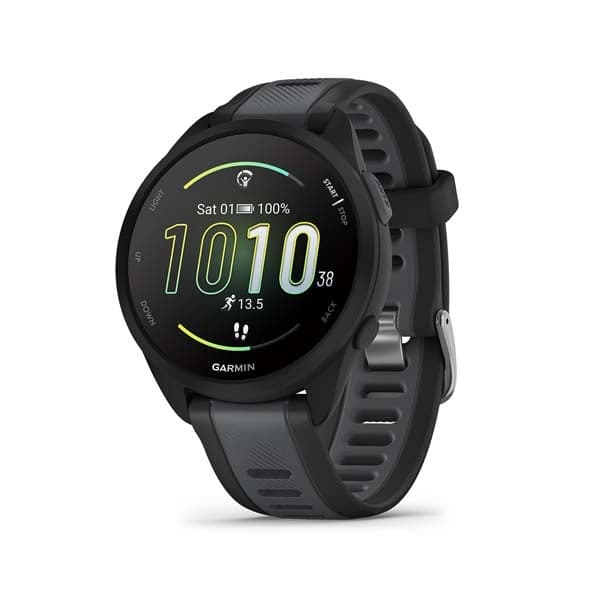
Garmin Forerunner 165. If running is the point rather than a side quest, Garmin's Forerunner range is the straightforward pick. The 165 has a suggested retail price of S$379 in Singapore, or S$459 for the Music edition, with up to 11 days of battery in smartwatch mode and built-in GPS. That battery figure is the real selling point: you can train all week and not think about the charger.
One Singapore-specific reason to buy local here is warranty. Garmin honours warranty only for the region of purchase. A unit bought in Singapore on or after 1 January 2024 gets a 1+1 local extended warranty, while a grey-market unit bought overseas isn't covered locally. The few dollars you save importing vanish the first time it needs a repair.
Why it matters: real GPS, multi-day battery and a local warranty beat a marginally cheaper grey import you can't get serviced.
Best for recovery and sleep
Oura Ring 4 for sleep, if you'll wear a ring. A smart ring is the most comfortable thing to sleep in, and the evidence backs the tracking. Oura Ring 4 retails around S$529 to S$599 in Singapore through sellers like Ante Limited, all finishes priced the same, with a one-year guarantee. The catch is the membership: full insights need Oura Membership at about US$5.99 a month or US$69.99 a year, with the first month free.
The research is genuinely solid on rings for sleep. A 2024 validation against polysomnography put Oura's epoch-level accuracy at roughly 92% across sleep stages, and a separate hospital comparison made it the most accurate consumer device for four-stage sleep at about 79% agreement, against the roughly 83% agreement you'd get between two human scorers on the same night. No consumer device matches a sleep lab, but rings are the strongest consumer option here. For the hands-on call on the latest ring, see our Oura Ring 5 review.
Whoop 5.0 if you want recovery coaching and don't mind renting. Whoop sells hardware bundled with a mandatory annual membership in three tiers: One at S$259 a year, Peak at S$349, and Life at S$529 (the Life tier uses the WHOOP MG hardware for its ECG and blood-pressure features, some of which aren't yet enabled in Singapore). Singapore packs start around S$118 to S$227, with spare bands running S$69 to S$169.
Read the subscription clause before you commit. Whoop's device stops working without an active subscription: cancel and the band becomes a bracelet, unable to show, sync or export your data. Three years on the Peak tier comes to a little over S$1,000 in membership alone, on top of the hardware. That's the subscription tax in one line. Against a subscription-free Apple Watch over the same period, "cheap upfront" stops being cheap. For hardware and app scoring, see our WHOOP 5.0 review (7.8/10).
The subscription is the product: a Whoop band stops showing or exporting your data the moment you stop paying.The Catalyst Feed
Why it matters: rings win on sleep comfort and accuracy; Whoop wins on coaching; both can cost more over three years than a watch with no subscription at all.
Best budget
A Xiaomi Smart Band or a free HPB tracker. You do not need to spend watch money to count steps and sleep. A sub-S$100 Xiaomi band covers steps, heart rate, SpO2 and sleep and qualifies for Healthy 365 Healthpoints. Even cheaper: HPB-compatible trackers like the AXTRO Fit 4 (steps, heart rate, SpO2, sleep, 5 to 7 day battery, sweat and splash resistant) sit in the roughly S$25 to S$40 band, and you can collect an AXTRO Fit 4 free through the Healthy 365 National Steps Challenge.
Here's the part the price tags don't tell you: in a 2026 multi-device validation test, the mid-priced Fitbit Charge 6 posted the best heart-rate accuracy (MAE 4.5 bpm), ahead of pricier devices. More expensive tracks more features and a slicker ecosystem, not raw sensor accuracy.
Why it matters: for steps, sleep and Healthpoints, a free or sub-S$100 tracker does the job a S$600 watch does, minus the ego. If price is the whole brief, our best budget fitness trackers guide breaks down the sub-S$120 bands by what you give up.
Best for everyday health tracking
If you want ECG, blood oxygen and sleep apnoea notifications, the field is the Series/Ultra Apple Watches, the Whoop Life tier and the higher-end Android watches. One firm caveat for Singapore buyers: these are wellness features, not medical devices. Under the HSA framework, wearable features sold purely for well-being aren't regulated as medical devices as long as the labelling says they're not for medical use. An irregular-rhythm or low-oxygen alert is a prompt to see a doctor, not a diagnosis.
Why it matters: treat the notification as a nudge to get checked, never as a verdict.
The Singapore factors that change the decision
Heat and sweat. The popular fear is that tropical heat wrecks heart-rate accuracy. The bigger 2026 validation evidence disagrees: across neutral, hot and cold conditions there was no statistically significant effect of ambient temperature on optical heart-rate accuracy. What actually degrades a wrist reading is motion, sweat-driven slippage and a loose fit during hard intervals. So tighten the band before a HIIT session, and for serious interval work consider a chest strap or arm band, where upper-arm placement stays more accurate as intensity climbs.
Healthy 365 and the LumiHealth shutdown. The Apple–HPB LumiHealth programme concluded on 31 May 2026 after engaging more than 377,000 Singaporeans, so your Apple Watch no longer earns coins through it. Rewards now flow through Healthy 365, which earns Healthpoints from HPB-issued trackers (AXTRO Fit series, Tempo, Careeach HR, Glide HR) and syncs with Fitbit, Garmin Connect, Huawei Health, Polar Flow and Samsung Health. Check your specific sync path before assuming you're earning.
Warranty. Buy from an authorised Singapore retailer. Most brands, Garmin included, only honour warranty in the region of purchase.
FAQ
What is the best fitness tracker for iPhone users in Singapore?
Apple Watch Series 11 or SE 3 if you want the full ecosystem. Check authorised Apple pricing and whether you need cellular for runs without a phone.
Best tracker for Android in Singapore?
Samsung Galaxy Watch 7 on Samsung phones, or Pixel Watch 3 on Pixel. Garmin remains the runner-first option without phone lock-in.
Does warranty matter for wearables in Singapore?
Yes. Grey-market imports may lack local Garmin or Apple service. Buy from authorised sellers if you expect multi-year use in humid conditions.
Which trackers work with Healthy 365?
Only HPB-approved models earn rewards. Verify compatibility on the official Healthy 365 device list before buying for points.
Should I worry about subscription costs?
Some recovery devices rent you the experience monthly. Factor three-year total cost, not just the box price. Our subscription cost guide walks through the maths.
Sources
- Apple Watch SE 3: Apple Singapore
- Garmin Forerunner 165: Garmin Singapore press release
- Oura Ring 4: Ante Limited (Singapore retailer)
- WHOOP membership tiers: WHOOP
- WHOOP total cost of ownership: MyHRV
- Google Pixel Watch 3: Google Store Singapore
- LumiHealth programme to conclude on 31 May: Health Promotion Board
- Healthy 365 authorised service providers: HealthHub
- AXTRO Fit 4: AXTRO Sports
- Garmin Singapore consumer limited warranty: Garmin Support
- Regulatory overview of medical devices: Health Sciences Authority
- Accuracy of Optical Heart Rate Measurements for 10 Commercial Wearables: JMIR Formative Research (2026)
- Validity and reliability of the Oura Ring Gen 3 vs polysomnography: Sleep Medicine (2024)
- Consumer wearable sleep-staging comparison: Sensors (2024)
- Wrist-Worn and Arm-Worn Wearables for Monitoring Heart Rate: JMIR Cardio (2025)
Spot an error or have a product we should test? We read every note.
Get in touch